-
『역주 사법품보(司法稟報)』, 시대를 번역하다
-
Annotated Sabeoppumbo, Translating an Era
(한국학분야 토대연구지원사업, 2012, (연구책임자) 한상권, <<사법품보(司法稟報)>> 번역 및 역주, 덕성여자대학교)
오연숙
(덕성여대 역사문화연구소)
『사법품보(司法稟報)』는 1894년 사법제도 개혁 이후 재판 관련 기록물로, 1894년부터 1907년까지 각 도에 설치되었던 지방재판소 등에서 중앙의 법부(法部)에 재판 결과를 보고하거나 재판에 대해 질품(質稟)하는 문서 등이 수록되어 있다. 여기에는 당시 정치, 경제, 사회, 문화 등 다양한 사회상이 나타나 있을 뿐 아니라, 격동하는 시대적 변화에 어떻게 대응하였는지가 잘 나타나 있다.
『사법품보』는 총 180책(서울대규장각한국학연구원 소장, 갑 128책, 을 52책)으로 제책되어 있으며, 아세아문화사에서 총 20권으로 영인하였다. 이 책을 번역하기 위해 2010년 1월 『추안급국안(推案及鞫案)』 번역팀원과 한국역사연구회 회원 등이 주축이 되어 번역팀을 구성하였다. 다행히 2012년 한국학중앙연구원 한국학진흥사업단의 번역 지원사업에 선정되어, 덕성여대 역사문화연구소 『사법품보』번역팀(연구책임자 : 한상권, 이하 번역팀)은 본격적인 역주작업에 착수하였다.
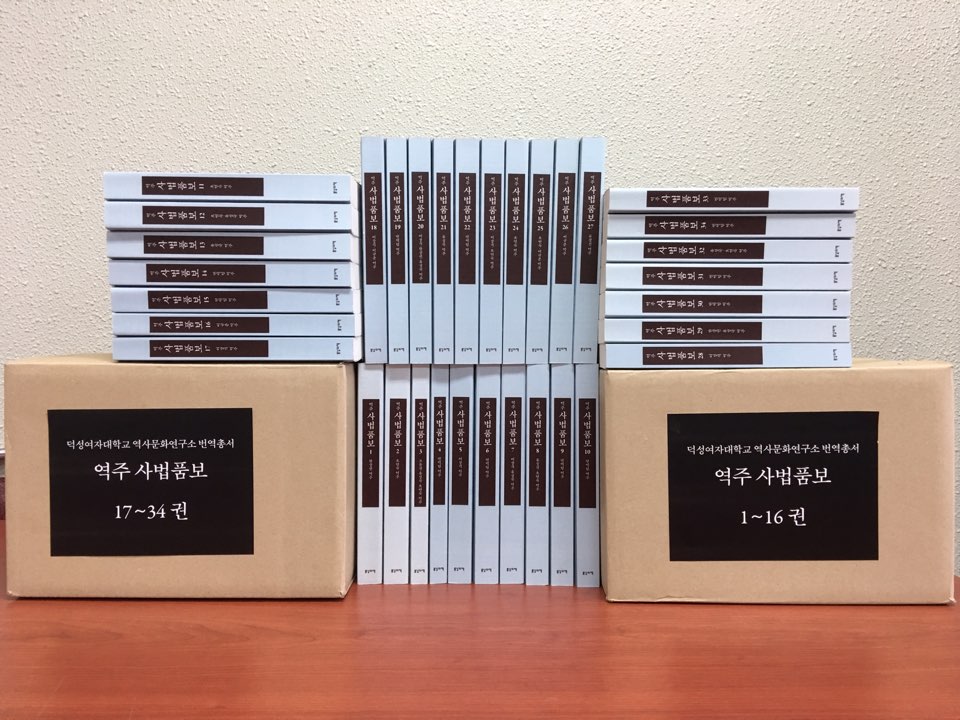
이렇게 시작된 번역사업은 한국학중앙연구원 한국학진흥사업단의 지원(2012-2015)과 이후의 서울대학교 규장각한국학연구원의 지원(2016-2018)으로『사법품보』영인본 20권 가운데 13권의 번역을 완료하였고, 2018년『사법품보』총 40권을 출간하게 되었다.
『사법품보』가 거질인 만큼 번역팀은 번역의 완성도를 높이기 위한 방법을 다각도로 고심하였다. 첫째, 번역의 일관성을 유지하고 수준을 제고하기 위해 번역 및 출판 워크숍을 정례적으로 개최하였다. 어감이나 어투의 불일치, 용어의 차이 등 공동 번역에서 제기될 수 있는 문제점을 극복하고자 하였다. 둘째, 각자 분담한 번역물을 상호 교차 검토하여 논의하고 교정하는 과정을 거쳤다. 교차검토를 통해 상호 소통함으로써 용어일치 등 번역의 통일성을 기하고 오자 및 탈역의 방지를 통해 번역의 신뢰성 및 질적 향상을 도모하였다. 셋째, 자체적인 번역평가도 병행하였다. 평가의 전문성과 공정성, 실효성을 담보하기 위해 외부 전문가에게 의뢰함으로써 번역의 질적 수준을 제고하려고 노력하였다. 넷째, 번역용어사전을 발간함으로써, 번역의 일관성을 유지하고, 자주 발생하는 오류 부분을 시정하여 번역의 완성도를 높이려고 하였다.
『사법품보』는 근대이행기 사법제도를 파악하는데 중요한 자료이다.『사법품보』에는 기존의 관찬 연대기류 사서에서는 찾아볼 수 없는 다양한 사건과 사법절차 및 운영에 대한 보고서(報告書), 판결선언서(判決宣言書), 판결요지(判決要旨) 등 풍부한 사례를 수록하고 있어 근대사법제도 도입의 실상을 파악할 수 있다.
『사법품보』에는 정치, 경제, 사회, 문화의 다양한 모습의 범죄 양상이 담겨 있다. 각 지방 재판소의 재판 관련 기록을 통해서 갑오개혁 이후 지배층과 피지배층의 갈등을 조명할 수 있는 내용이 상세히 수록되어 있다. 그리고 수많은 인물들이 등장하여 근대 이행기 인물 프로파일링(profiling)과 민중의 온톨로지(ontology)를 정립하는 토대 자료가 된다. 또한 근대 전환기 여성을 포함하여 민중에 대한 삶의 변화 양태를 살펴 볼 수 있으며, 동학농민전쟁 이후 농민전쟁 참여자들의 행적을 살펴 볼 수 있다. 나아가 서구 문물의 유입 등으로 전통문화와 서양문화가 충돌하는 과정에서 발생하는 각계각층의 다양한 갈등과 대립 또는 수용 양상이 각종 정치적, 경제적, 사회적 사건들 속에 담겨 있어 당대인들의 시대인식을 파악할 수 있다. 이를 통하여 19세기 말, 20세기 초 민중들의 삶을 구체적으로 복원할 수 있는 스토리텔링의 풍부한 자료를 얻을 수 있다.
또한 갑오개혁기와 대한제국기 각종 공문서 양식이 수록되어 있어 기록문화의 변화 양상을 살펴 볼 수 있고, 국한문혼용체로의 전환 과정에서 한국어가 정리되어 가는 과정을 살펴 볼 수 있다. 이러한 점에서『사법품보』는 관찬기록이면서도 정치와 지배자 중심의 기록인『조선왕조실록』, 『승정원일기』 등과는 차별화되고 또 다른 가치가 있는 중요한 자료로 평가할 수 있다.
이렇듯 자료적 가치가 큼에도 불구하고『사법품보』는 그동안 학계의 연구에서 많은 주목을 받지 못하였다. 이러한 원인들 중에는 자료가 아직 제대로 소개·정리되지 않은 탓도 있지만, 가장 큰 원인은 번역이 되어 있지 않았다는 점이다.『사법품보』가 비록 국한문혼용이라고는 하지만, 결코 이해가 용이하지 않음으로 인해 한글세대 연구자들에게『사법품보』는 또 하나의 ‘외국어서적’으로 인식되고 있는 것이다. 한편 최근 원 자료, 특히 법제사 관련 자료에 대한 관심과 요구는 깊이를 더하고 있고, 영역도 더욱 더 확대되어 가고 있는 실정이다. 관련분야의 다양한 전공자가 참여하여 정확하고 쉬운 역주작업과 축자번역을 통해 얻어진 이 번역물은 당대의 정치, 경제, 문화, 사회 등의 연구에 커다란 도움이 예상된다.
이 책의 번역출판을 계기로 누구나 활용할 수 있고 다양한 효과를 기대해 볼 수 있다. 역사학, 국어학, 사회학, 법사학 등 다양한 학문 분야의 공동연구의 활성화로 19세기 말, 20세기 초의 사회구조를 전체적으로 조망할 수 있다. 한문의 장벽으로 활용하지 못했던 자료를 번역함으로써 사료에 대한 접근을 용이하게 만들어 연구 생산성 증대, 전통문화 자료 이용이 확대되어 민중생활사, 법제사 연구 등 이 시기 역사서술을 풍부하게 만들 수 있다. 이를 통해 아직까지 미개척 분야로 남아 있는 ‘범죄사회사’를 비롯한 새로운 연구 분야 개척에도 많은 기여를 할 수 있을 것이다. 아울러『사법품보』에 실린 각종 「죄안(罪案)」과 검안(檢案),『증수무원록(增修無冤錄)』의 법의학 관련 자료, 다양한 범죄와 인물, 일상생활 양상은 드라마, 소설, 영화, 캐릭터 개발 등 문화산업 소재로 이용할 수 있으며, 다양한 시각에서 접근하고 있는 사극 등을 비롯한 각종 문화콘텐츠 개발에 커다란 자산이 될 것이다.
이처럼 활용도가 큰『사법품보』는 다행히도 그동안 한국학중앙연구원 한국학진흥사업단과 서울대학교 규장각한국학연구원의 지원으로『사법품보』의 3분의 2정도 분량의 역주가 완료되어 이제 출간하게 되었다. 번역팀은 남아있는 3분의 1의 역주작업도 잘 마무리되기를 기대해본다.『사법품보』 영인본 20권의 번역을 완료하면『역주 사법품보』는 총 70여 권에 이를 전망이다. 이로써 ‘10년 프로젝트’가 완결되는 셈이다.
Annotated Sabeoppumbo, Translating an Era
OH, Yeon-suk
(Duksung Women’s University, Institute of History and Culture)
As an archive of judicial documents written after the 1894 judicial reform in Joseon, the Sabeoppumbo contains reports of judicial findings of local courts established in each province which were being reported to the central court and also contains documents making inquiries from the local courts to the central authorities written between 1894 and 1907. These records not only display the political, economic, social, and cultural, etc., issues of that time, but also show how people were responding to the turbulent transformations of the era.
The Sabeoppumbo (stored at Kyujanggak Institute for Korean Studies, Seoul National University) is bound into a total of 180 volumes (128 gab volumes and fifty-two eul volumes), and the Asia Culture Publishing Company has photocopied them into a total of twenty volumes. The translation team for Chuangeupgukan and members of the Korean History society played a key role in the translation of this book, the project beginning in January 2010. Thankfully this project was selected by the Korean Studies Promotion Service of the Academy of Korean Studies to be part of the program supporting translations, and the Sabeoppumbo Translation Team at the Institute of History and Culture at Duksung Women’s University (referred to as Translation Team in the following; project head: HAN, Sang-gwon) set to work.
With the support of the Korean Studies Promotion Service from 2012 to 2015, and then from the Kyujanggak Institute of Korean Studies from 2016 to 2018, thirteen of the twenty photocopied volumes of Sabeoppumbo were translated and in 2018 were published under the title Annotated Sabeoppumbo.
Given the magnitude of Sabeoppumbo, the Translation Team approached the translation from many different angles. First, translation and publication workshops were routinely held to maintain and enhance the level of consistency. This was done to overcome issues such as differences in nuance and tone or differences in terminology which are common in collaborative translations. Second, each member’s translations were exchanged amongst the group for review and discussion before being revised. Through this cross-review system, mutual communication led to consistency in terminology and improved unity of the translation. Also, this system helped prevent errors and omissions thus improving the reliability and quality of the translation. Third, a self-translation evaluation was also simultaneously carried out. This was done in an effort to improve the quality of the translation by requesting outside experts to review the professionalism, fairness, and effectiveness of the evaluations. Fourth, the consistency of the translation was maintained through the development of a dictionary of terms for the translation, and mistakes that frequently occurred were rectified to improve the completeness of the translation.
Sabeoppumbo contains important records for understanding the judicial system during the modern transitional period. Within its pages there are many reports, rulings, and arguments on rulings regarding a variety of events and judicial procedures and operations. Thus Sabeoppumbo, more so than the existing government records, provides a copious amount of cases through which to understand the truth behind the introduction of a modern judicial system in Joseon.
Sabeoppumbo displays various forms of crimes including political, economic, social, and cultural. The judicial records of each local court comprise details illuminating the tensions between the ruling and subjected classes after the Gabo Reforms. Furthermore, many different figures emerge in the documents making them a useful foundation for establishing a profile of the various people of the times and the ontology of the people. Also, the documents allow us to observe the changes in the lives of the people, including women, during the transition to the modern era, and also provide a record of what happened to the farmers who participated in the Donghak Peasant Uprising. Additionally, an understanding of how the people of that era perceived the times in which they were living can be gleaned from the various political, economic, and social events which display the tensions and accommodation among the classes amidst the clash between traditional culture and Western culture, which was being introduced to Korea at that time. There are plenty of documents which allow us to concretely retell the story of the people living in the late nineteenth and early twentieth centuries in Joseon.
An examination of the changes in the culture of recordkeeping can be made through studying the format of the official documents prepared during the Gabo Reform and Great Korean Empire period. A study can also be made of how the Korean language was shaped during this period through the transition to using a mix of Korean and Chinese characters. In this way, while it was an official government archive, Sabeoppumbo can be considered important as it should be distinguished from the political and ruling class-centered records contained in the Joseonwangjosillok and Seungjeongwonilgi.
Even though the Sabeoppumbo is very useful in the study of history, it has not received much attention from academia. Sabeoppumbo is written in a mix of Korean and Chinese characters yet it is not easy to understand and is perceived as a “foreign language work” by researchers of the age of Hangeul. Recently interest in and demand for primary source documents, especially those related to the history of law, has deepened and the areas of study has expanded even wider. It is expected that this translation, which was done accurately and verbatim by experts from a variety of fields, will be of great use in researching the politics, economics, culture, and society of that era.
With this publication anybody can now use these materials and we expect this to have a variety of effects. It may invigorate joint research among scholars from a many fields, including history, Korean language and literature, sociology, and law, etc., to provide an overall survey of the late nineteenth and early twentieth century Joseon social structure. With this translation, documents that were once difficult to use due to the Chinse characters have become easily approachable, and now research production can increase and the use of traditional documents widened so that many historical descriptions of this era, including those on the everyday lives of the people and of the legal system, can be made. New fields of study such as “social history of criminality” which as of yet are unexplored can be pioneered in part based on this translation. And documents related to forensic science such as “Juian,” “Geoman,” and Jeungsumuwonlok, the various criminals and people, and reports on daily life that are recorded in Sabeoppumbo can be used in a variety of cultural products such as dramas, novels, movies, and characters. It should be a great asset in the development of many types of cultural contents including historical dramas that illuminate the past from a variety of perspectives.
In this way, it is fortunate that through the support of the Korean Studies Promotion Service of the Academy of Korean Studies and the Kyujanggak Institute of Korean Studies at Seoul National University two-thirds of Sabeoppumbo was translated with annotations and is now published. The Translation Team is expected to finish the remaining one-third in the future as well. Annotated Sabeoppumbo is expected to be about 70 volumes-long when the translation of the remaining volumes of the facsimile edition of the Sabeoppumbo is finished, thus culminating a “ten-year project.” (Translated by Benjamin A. Engel)
-
글쓴날 : [18-10-24 14:11]
