-
『식민지 조선 농촌의 일본인 지주와 조선 농민』과 식민지 지주제 연구
-
Japanese Landlords and Korean Peasants in Rural Colonial Korea and Research on the Colonial Landowner System
하지연
(이화여대 이화사학연구소)

『식민지 조선 농촌의 일본인 지주와 조선 농민』(경인문화사, 2018)은 필자의 식민지 지주제에 관한 첫 번째 저술이었던 『일제하 식민지 지주제 연구』 (혜안, 2010)에 이어 이 시기 일본인 거대지주에 관한 두 번째 사례 연구이다.
필자가 시부사와 에이이치(澁澤榮一) 자본계열의 조선흥업주식회사(朝鮮興業株式會社)로 학위를 받던 무렵 한국 근대사 학계의 ‘식민지 근대화 논쟁’은 일정 정도 단계를 넘어서 이미 내재적 발전론이나 수탈론의 기조는 속류화된 시점이었다. 그런데 필자의 연구대상은 일본인 지주회사였으니 사실상 연구의 결론은 답이 정해진 주제였다. 그럼에도 불구하고, 미쓰비시(三菱) 계열의 동산(東山)농사주식회사, 가와사키(川崎) 농장 등 식민지 시기 일본인 지주에 관한 사례 연구를 지속하던 중 마침 2013년 한국학중앙연구원 한국학진흥사업단의 한국학총서 사업에 “근대 전환기의 국가와 민”이란 주제로 배항섭(연구책임), 이영호, 손병규, 김건태, 김현숙, 이승일 선생님과 함께 3년간의 공동 연구를 진행하게 되었다.
연구팀은 “국가와 민”이란 대 주제를 다시 제1부 “국가의 지배와 분배”와 제2부 “민의 삶과 문화”로 나누었고, 필자는 ‘식민지 조선 농촌의 일본인 지주와 조선 농민’이란 소주제를 가지고 제2부에 참여하기로 했다. 그러나 공동연구주제가 “국가와 민”인데, 필자의 연구주제는 식민지 지주제였다. 과연 식민지를 국가로 규정할 수 있는가? 라는 의문이 들었다.
결론부터 말하자면 식민지는 정상적인 국가 상태로 규정할 수 없다. 이미 외부 식민자들에 의해 현지 권력이 대체되었고, 식민지 민중의 동의 없이 혹은 저항 속에 식민권력은 모든 국가의 중심적 기능을 행사하면서 식민지는 주권이 유린되고, 제반 경제 분야의 이윤은 식민권력과 본국 자본가, 그리고 그에 기생한 토착 자산가들에게 돌아가는 왜곡된 구조로 설명된다. 따라서 필자는 “국가와 민”이라기보다는 “식민권력과 민”이라는 설정 하에 접근했다. 또 이 때 식민권력은 조선 총독부와 같은 식민지 행정권력뿐만 아니라 실질적으로 식민지 조선 농민들의 생계를 움켜쥐었던 식민지 조선 농촌의 일본인 거대 지주(회사)들이었다.
이러한 고민 속에서 식민지 시기 대표적인 일본인 거대 지주들의 농장들이 어떤 구체적 방식으로 조선인 소작 농민들을 속속들이 구속하고, 제어해 갔으며, 농업 현장에서 씨뿌리기에서 풀 뽑기, 비료주기, 추수, 소작미 납입 등 영농 전 과정을 철저하게 간섭해 가며 농업 경영상의 식민성과 근대성을 동시에 드러내었는지 검증해 보고 싶었다. 그리고 그 사례 연구로 이시카와현농업주식회사(石川縣農業株式會社), 불이흥업주식회사(不二興業株式會社), 구마모토(熊本)농장, 동양척식주식회사(東洋拓殖株式會社)를 택했다. 워낙 이름만 들어도 굴직굴직한 식민지 시기 대표적인 일본 거대 지주회사들이다. 그리고 어지간히 학계에서 연구들이 진행되었던 상황이었다. 그런데 막상 구체적으로 아주 세밀하게 이들 지주회사들이 영농 현장에서 어떤 관리조직을 이용하여 혹은 관리인을 매개하여 조선 소작인들을 직간접적으로 일일이 통제하고 관리했는가에 대해서는 면밀하게 분석한 연구는 그리 많지 않았던 것 같다.따라서 이 저서는 식민권력에 의해 강제되어지는 일본식 농법과 품종개량 등으로 변화하는 조선 농촌의 모습, 외부로부터 강제된 이질적 영농 문화와 각종의 규율 및 통제 등에 대한 실증적 사례 연구가 될 것으로 기대한다. 또한 그것은 현재 우리 근대사 학계에서 여전히 예민한 주제인 ‘식민지 근대성과 식민성’의 문제에 대해 식민지 시기 일본인 거대 지주회사(농장)에 의한 농장 경영이 조선 재래의 지주제나 농업경영에 비하여 과연 ‘근대적’이고 ‘합리적’이며 ‘효율적’이라는 평가가 가능한가에 대해서는 ‘더 합리적’이라기보다는 ‘더 자본주의적’인 경영방식이었음을 확인하는 작업이었다.
Japanese Landlords and Korean Peasants in Rural Colonial Korea and
Research on the Colonial Landowner System
Ha Ji Yeon(Ewha Institute of History, Ewha Womans University)
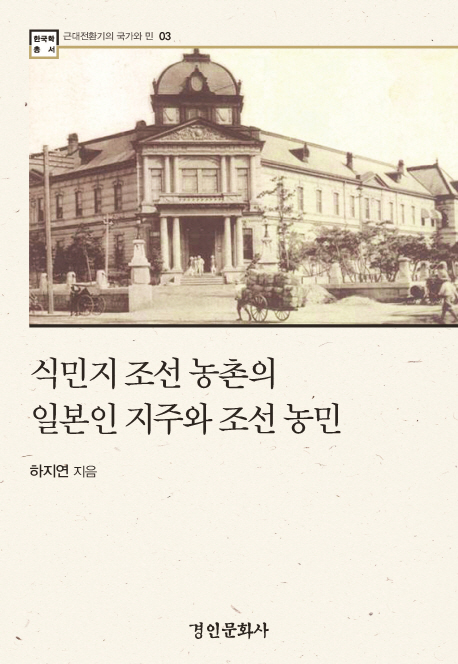
Japanese Landlords and Korean Peasants in Rural Colonial Korea (Kyungin Publishing, 2018) is my latest work on large landowning Japanese residents of Korea during the colonial period following my first book on the colonial landowner system entitled Research on the Japanese Colonial Landowner System.
At the time I was completing my degree through research on the Joseon Heungeop Company, an affiliate of Shibusawa Eiichi, the “argument over colonial modernization” among scholars of the modern era had advanced to a point where the internal development theory and colonial exploitation theory had become commonplace. However, given that my research topic was a Japanese land holding company, the conclusion was predetermined. Nevertheless, while continuing to conduct research on colonial Japanese landowners including the Dongsan Agricultural Company, an affiliate of Mitsubishi, and the Kawasaki Farm, etc., the author was invited to join a three year joint Korean Studies Series’ research project of the Korean Studies Promotion Service of the Academy of Korean Studies in 2013 entitled “The State and the People in Modern Times” with Bae Hang-seop (Director), Lee Yeong-ho, Son Byeong-gyu, Kim Geon-tae, Kim Hyeon-suk, and Lee Seung-il.
The research team took the topic of “The State and the People” and divided it into two sections: “State Control and Distribution” and “The Lives and Culture of the People.” It was decided that I would contribute to the second section under the subtitle of “Japanese Landlords and Korean Peasants in Rural Colonial Korea.” However, the joint research topic was “The State and the People” while my subject was the colonial landowner system, leading to the question of “can a colony be classified as a state?”
To start from the conclusion, a colony cannot be deemed a normal country. Local power had been superseded by the colonizers, and the central functions of the state are controlled by the colonial power without the agreement of the colonized and despite their opposition. Colonialism violates sovereignty and the profits generated from various fields of economic activity go to the colonial power, capitalists from the home country, and parasitic native property owners under a distorted economic structure. Therefore, I approached the research from a framework of “The Colonial Power and the People” rather than “The State and the People.” Also, the real force taking hold of the livelihood of the Korean peasants was not only the administrative power of the Government-General of Korea, but also the large Japanese landowners and land holding companies.
While considering these issues, I wanted to review the specific means that the farms of representative large Japanese landowners used to thoroughly shackle and control the Korean tenant farmers, how these landowners drastically interfered in the entire agricultural process, including planting, weeding, fertilizing, harvesting, and payment, and the nature of both colonial and modern farm management. This was done through four case studies of the Ishikawa Prefecture Agricultural Company, the Buri Heungeop Company, the Kumamoto Farm, and the Oriental Development Company. The names alone signify that these entities were the representative large landowners of the Japanese colonial era, and there has been a fair amount of academic research on these cases. However, it seems there are few studies meticulously analyzing the management procedures these land holding companies used on farms or how the Korean tenant farmers were directly and indirectly controlled one by one through middlemen.
Therefore, this book is expected to provide empirical case studies on the changing nature of Korean farming villages due to imposition of Japanese agricultural techniques and plant breeding by the colonial landowning power and the foreign agricultural culture and various forms of punishment and controls imposed from the outside. Furthermore, while many in Korean academia are still sensitive to questions of “colonial modernity and coloniality,” this work confirms that the answer to the question of whether the agricultural management of large Japanese land holding companies and farms was more “modern,” “rational,” or “effective” than the traditional Joseon tenant system and agricultural management methods is that colonial management can be deemed “more capitalist” rather than “more rational.”(Translated by Benjamin A. Engel)
-
글쓴날 : [18-06-22 09:37]
